
Tango Kilo Mike
Charitable Trust
The Fog of Ambiguity: How Unclear Expectations Undermine Our Lives
Unclear expectations, often referred to as role ambiguity, do not merely lead to minor irritations or missed deadlines; they create a pervasive, insidious fog that depletes cognitive resources, fractures relationships, and ultimately diminishes a person's quality of life. Understanding this impact requires delving into the deep-seated psychological need for predictability and control.
The Psychology of Ambiguity: The Cost of Cognitive Noise
At a foundational level, the human brain is a prediction machine. It constantly seeks patterns and clarity to conserve energy. When expectations are vague ("just do your best," "be more proactive," or "we’ll figure it out later"), the brain cannot create an efficient plan, forcing it into a state of continuous, high-intensity processing known as cognitive load.
This ambiguity is processed as a threat to one's competence and safety, triggering the sympathetic nervous system (fight-or-flight). Individuals spend unnecessary time and mental energy attempting to infer the true requirement, second-guessing decisions, and seeking constant reassurance. The psychological result is a constant, low-level operational deficit, diverting energy away from actual productivity and creativity.
Emotional States: The Acute and Chronic Toll
In the short term, vague requirements lead to immediate and intense emotional spikes:
Anxiety and Stress: The fear of failure, coupled with the inability to properly allocate time and resources, fuels intense anxiety. This acute stress initially pushes performance (as described by the Yerkes-Dodson Law), but the stress is quickly compounded, pushing the individual past optimal performance into a zone of emotional overload.
Frustration and Anger: When effort is expended but misses the mark, often because the target was undefined, it leads to deep frustration, which can manifest as outward anger or internal resentment toward the person or system that failed to provide clarity.
Chronic Stage: Helplessness, Burnout, and Depression
If the lack of clarity persists, the emotional state shifts from an active struggle to a state of resignation:
Learned Helplessness: This is perhaps the most damaging chronic effect. Repeated attempts to succeed under ambiguous conditions, followed by perceived failure, teach the individual that their effort is futile regardless of their approach. They stop trying to figure things out, leading to inaction and emotional withdrawal.
Burnout: The continuous cognitive load and emotional strain exhaust the body’s reserves. Chronic ambiguity is a major precursor to burnout, characterised by cynicism, de-personalisation, and reduced professional efficacy.
Apathy and Depression: The long-term loss of control and the erosion of self-efficacy contribute significantly to feelings of hopelessness and clinical depression.
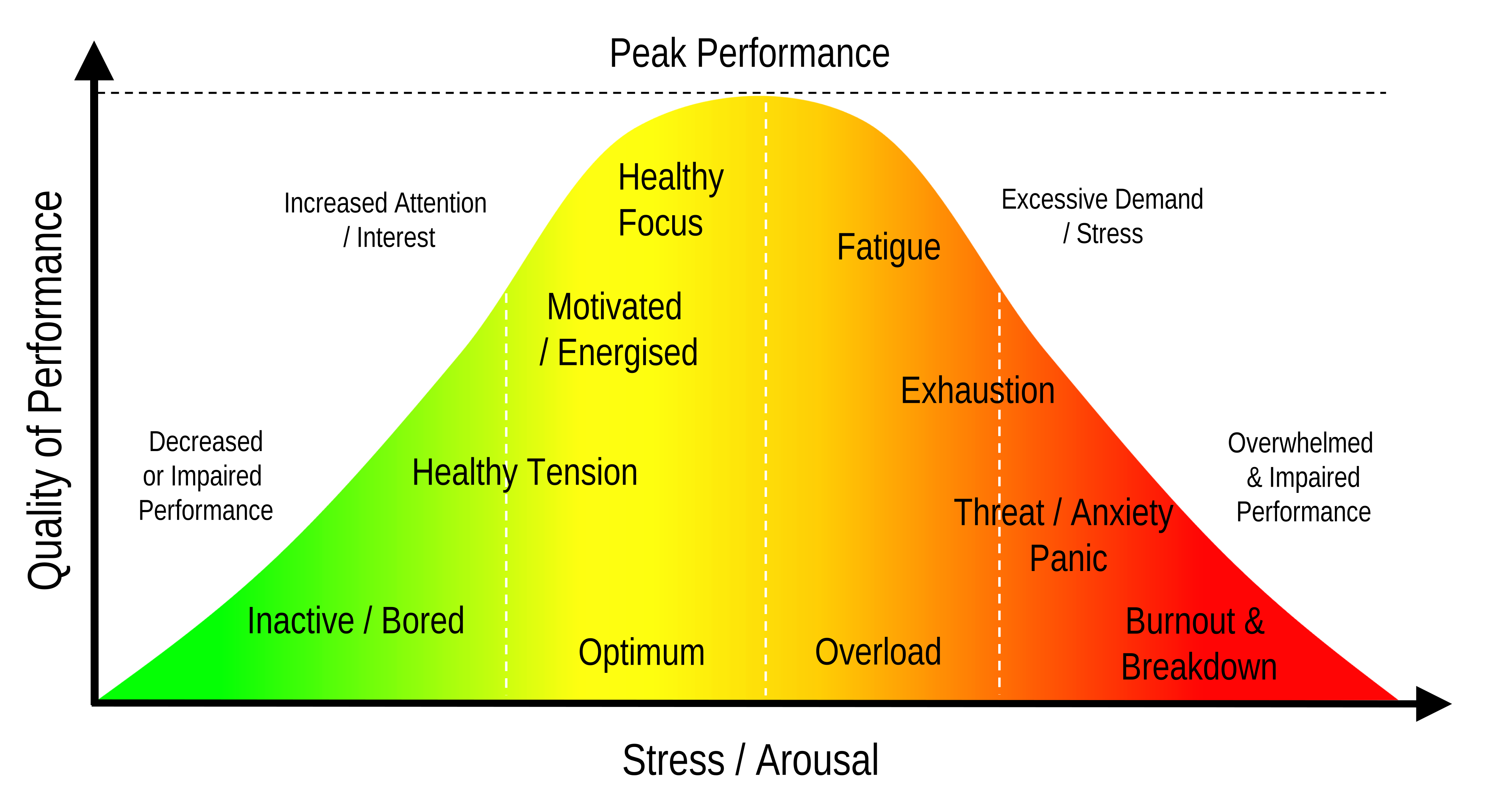
Manifestation in Behaviour and Life Domains
The internal emotional toll translates directly into observable behaviours and tangible damage across life domains:
Domain
Impact
Example
Work
Procrastination, micromanagement, low morale, role conflicts, etc.
"Make this look better". What is "better"?
Home
Passive-aggression, resentment, unfair division of labour, conflict avoidance, etc.
"Can you help out more with the house?" What specific tasks need doing?
General Life
Goal paralysis, indicisiveness, relationship strain (as partners become emotional detectives), etc.
"I should probably be healthier". Undefined plan, lack of measurable steps.
At work, the ambiguity turns employees into micromanagers (of themselves and others) as they desperately try to create structure where none exists. At home, the stress leaks out as avoidance or misplaced criticism, often resulting in resentment as one partner feels they are carrying an invisible mental load the other partner cannot see or define.
The Specific Crucible: Military and Emergency Services Transition
For individuals transitioning out of high-stakes, high-clarity environments, such as the military, law enforcement, or frontline emergency services, the transition into civilian life is particularly jarring due to the loss of defined expectations.
In uniform, clarity is mandatory for survival and efficiency. Expectations are often binary and absolute:
Dress Code: What to wear is a Standard Operating Procedure (SOP). There is no "business casual."
Time Sensitivity: Tasks have clear timelines (e.g., "Must be completed NLT 0800").
Chain of Command: Who to ask is explicitly defined.
Eating/Breaks: Times and locations are generally structured, even if flexible under mission stress.
Upon entering civilian life, the loss of this hyper-structure creates a psychological vacuum:
Acute Stress in Mundane Situations: A veteran might feel intense anxiety over what to wear for a new job interview because the civilian expectation ("dress professionally") is nebulous compared to the specific SOP of their previous life. The simple act of choosing clothes becomes a high-stakes, ambiguous problem.
Pacing and Task Completion: A first responder, trained to execute life-saving tasks with maximum speed, may struggle with the often slower, more collaborative, and ambiguous pacing of an office environment. Their ingrained habit of rapid, decisive action can be misinterpreted as aggression or impatience by colleagues who operate under flexible timelines.
Loss of Defined Identity: When their identity was tied to a role with crystal-clear duties, the ambiguity of a non-structured career path can feel like a profound loss of self, amplifying the feelings of helplessness and chronic anxiety. They must unlearn the necessity of hyper-vigilance and prediction that was once essential for their safety and success.
Translating Emotional States into Dysfunctional Behaviour
Whether in a veteran adapting to civilian life or a corporate employee, chronic ambiguity translates into dysfunctional coping mechanisms:
Avoidance (The Freeze): Overwhelmed by the options and the risk of choosing incorrectly, the individual avoids the task entirely. Procrastination becomes a defence mechanism against potential failure.
Conflict (The Fight): The individual preemptively challenges the expectations or the person setting them. This is often an attempt to force the situation into a clarified, binary choice ("Tell me exactly what you want, or I won't do it!").
Obsessive Compulsiveness (The Over-Structure): The person creates rigid, often unnecessary, personal rules and structures to compensate for the external lack of clarity. This includes over-planning, over-documenting, and micromanaging their own process, which further increases their fatigue.
The Antidote: Practicing Proactive Clarity
The antidote to the fog of ambiguity is Proactive Clarity. This is not a passive request for information; it is a deliberate, ongoing effort by all parties to replace inference with explicit definition, moving the burden of task structure from the anxious receiver back to the responsible assigner. It is about creating psychological safety and freeing up the brain to focus its energy on solving the defined problem rather than trying to define it.
Tangible Techniques for Creating Clarity
Proactive Clarity is achieved through structured questioning and documentation, treating every task as an opportunity to establish a contract for success.
1. The "Definition of Done" Protocol
This is the most critical step. Before starting any complex task, ask:
Success Metrics: "How will we both know this task has been successfully completed? What will the final output look like, and what standards must it meet?"
The "Why": "What is the ultimate purpose of this? Understanding the context helps me prioritise trade-offs when issues arise."
Non-Negotiables: "Are there any hard deadlines, resource constraints, or absolute rules I must adhere to?"
2. The 5 Ws and H Structured Inquiry
If the initial instruction is vague, frame the follow-up questions systematically:
What is the final deliverable? (e.g., a report, a conversation, a physical action).
Who is responsible for which part, and who needs to approve the final result?
When is the firm deadline, and when are the check-in points? (NLT—No Later Than).
Where will the work product be stored or presented?
How good does it need to be (e.g., draft quality, polished final, quick analysis)?
3. The Draft-Review Loop (Rapid Calibration)
For highly ambiguous tasks (like "be more creative"), don't try to deliver the whole solution. Instead, agree to a rapid prototyping loop:
"To ensure I'm on the right track, I will spend the first hour creating three quick concepts and send them to you for feedback. Which of these three approaches best aligns with your vision?"
The Psychological Safety Barrier: Protecting Against Poor Leadership
The most empowering aspect of Proactive Clarity is its ability to shield the individual from the punitive effects of poor leadership, often summed up by the concept: "You can't be told off for something you didn't know."
When an individual receives a vague request and proactively clarifies the terms (using the techniques above), they must always document the agreed-upon understanding and seek confirmation, often through email or a simple written summary.
The Clarity Contract: By documenting the definition of success, the individual transforms a nebulous expectation into a verifiable contract. If the manager or partner later attempts to criticise the outcome based on an unstated, assumed expectation, the individual has a professional, non-confrontational defence: "My understanding of the task, as confirmed on [Date], was to deliver X. If the required outcome has changed to Y, I need a new clarity contract and timeline."
This shifts the dynamic. It elevates the individual from being a passive victim of an ambiguous system (or poor manager) to an active participant in professional risk management. It instils self-efficacy, ensuring that the anxiety and effort spent are channelled into productive work, not internal turmoil.
Gauging Your Clarity: Are You Winning the War Against the Fog?
Proactive Clarity is a skill, and like any skill, its effectiveness can be measured by its outcomes. The true measure of whether you have successfully established a "Clarity Contract" lies not just in the documentation you create, but in the internal shifts you experience and the quality of your relationships.
Use the following indicators to self-assess your success. If you see the "Red Light" in any column, that is your signal to stop work and immediately initiate the Proactive Clarity sequence (Stop > Question > Document > Confirm).
Indicator
Clarity Achieved (Green Light)
Clarity Failed (Red Light)
Psychological State
You feel a sense of flow and mental focus. The mental struggle is against the difficulty of the task, not the definition of the task. You make decisive, high-quality trade-offs easily.
You experience constant cognitive noise; you are re-reading vague instructions, building multiple 'what-if' scenarios, and struggling to justify why you should start Step 1.
Emotional State
You feel calm confidence and ownership over the process. Errors or setbacks are seen as temporary obstacles. You feel motivated to execute.
You are dominated by dread or resentment when contemplating the task. You feel tension or physical tightness in your body in anticipation of potential failure or unfair critique.
Behavioural Manifestation
You start the task quickly and focus primarily on execution. You initiate concise, scheduled check-ins and deliver work punctually. You feel empowered to say 'no' to new requests that jeopardise the current Clarity Contract.
You resort to avoidance (procrastination) or over-processing (spending excessive time planning without executing). You seek unnecessary, non-authoritative reassurance from peers.
Relational Impact (Leadership/Stakeholders)
Your stakeholders are responsive and brief in check-ins. Feedback focuses on refining the work, not correcting the initial scope. You are viewed as a reliable partner and a problem-solver, enhancing professional trust.
Stakeholders are hard to pin down for review, or their feedback is consistently contradictory ("I thought you meant X"). You receive critique that is subjective and based on implied, unstated desires, fostering a sense of being unfairly targeted.
The Power of the Negative Manifestation
If you notice the "Red Light" behaviours, the procrastination, the anxiety, or the subjective critique, view this not as a personal failure, but as a diagnostic signal. The behaviour (e.g., avoidance) is merely the symptom; the root cause is the absence of a clear, confirmed Clarity Contract.
By internalising this self-assessment, you transform moments of stress into opportunities for corrective action. When anxiety spikes, you stop, check the table, identify the red light, and initiate the Proactive Clarity sequence. This disciplined approach is the final, essential layer of protection against the destructive effects of the fog.
Knowing When to Walk Away: Recognising Systemic Ambiguity
Proactive Clarity is a powerful personal tool, but it is not a cure for a toxic organisational culture. There is a critical point where the individual's effort to create clarity is met not with collaboration, but with resistance, hostility, or willful negligence. At this point, the issue is not you; it is organisational pathology.
Systemic ambiguity occurs when poor communication is deeply entrenched, often serving as a tool for dysfunctional management to maintain control or shift blame. Trying to fix this alone is like bringing a spoon to a tidal wave.
The Warning Signs of Systemic Failure
Look for these four signs that your repeated attempts at Proactive Clarity are being intentionally undermined:
The Weaponisation of Ambiguity: Your documented Clarity Contract (the confirmed email or memo) is actively ignored or dismissed in a disciplinary or performance review setting. The response is a version of, "You should have known better," despite the written agreement. This indicates that management prefers deniability over clear results.
The Clarity Backlash: When you ask structured questions, you are met with exasperation, passive-aggression, or the accusation that you are "too demanding," "not flexible," or "over-thinking it." This is a defence mechanism used to discourage the very communication necessary for success.
The Perpetual Pivot: You secure clarity on Task A, but before you can execute, the goal is changed entirely (Task B) without a clear rationale or acknowledgement of the wasted effort. This pattern shows a fundamental lack of strategic direction, rendering all attempts at long-term clarity futile.
Chronic Organisational Chaos: The ambiguity is not limited to your tasks; it affects everyone. Colleagues are visibly burnt out, departmental roles constantly overlap, and key decisions are repeatedly overturned. Your clarity efforts are simply a drop in an ocean of disorder.
The Self-Preservation Protocol
If you have consistently employed the Proactive Clarity techniques (Stop, Question, Document, Confirm) for a period of months and are still dominated by the "Red Light" emotional states (dread, helplessness, resentment), the most responsible course of action is self-preservation.
Leaving an organisation that systematically punishes clarity is not a failure of performance; it is a successful act of risk management. You are deciding that your mental health and professional self-efficacy are non-negotiable. By moving to a structure where your effort is matched by clear expectations, you are choosing an environment where your energy is channelled into contribution, not survival.
Help Tango Kilo Mike
Achieve their mission
Tango Kilo Mike Charitable Trust is a registered NZ Registered Charity: CC59166