
Tango Kilo Mike
Charitable Trust
Crossing the Valley of Disappointment
There is a moment in every learning journey when the enthusiasm begins to wane. The initial spark that drove us to take up a new skill, whether it be mastering a programming language or stepping onto the mats in martial arts, begins to flicker. We’ve shown up, we’ve put in the hours, and yet the results seem stubbornly absent. This is what James Clear refers to as the Valley of Disappointment - the emotional trough between effort and visible progress.
Clear’s book Atomic Habits has become a touchstone for anyone interested in personal development, not because it offers grand theories, but because it distils change into something practical and human. At its heart is the idea that small, consistent actions compound over time. But crucially, Clear acknowledges that this compounding is not immediately visible. The early stages of habit formation often feel unrewarding. You’re doing the work, but the payoff hasn’t arrived. That’s where many people give up - not because they’re incapable, but because they misinterpret the silence of progress as failure.
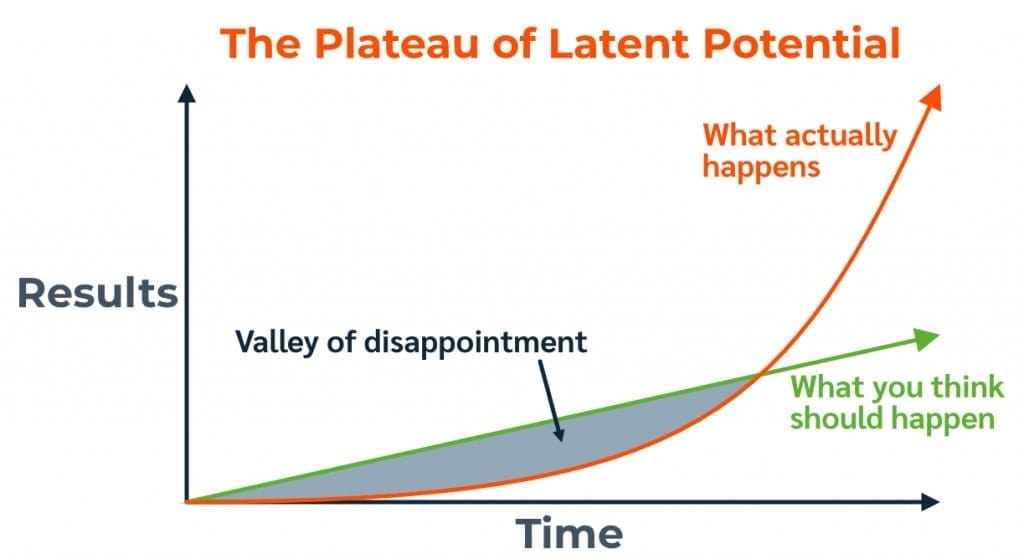
In martial arts, this valley often appears after the honeymoon phase. The basics are no longer exciting, the techniques feel repetitive, and the body resists refinement. In technology, it shows up when the tutorials stop making sense, when the errors pile up, and when the confidence dips. But in both cases, something vital is happening beneath the surface. Neural pathways are forming, instincts are sharpening, and identity is shifting. The progress is real, just not yet visible.
One of the most powerful ways to pierce through this fog is what I call a breakthrough session. In martial arts and exercise more broadly, this is a deliberate moment where either the intensity or the duration of training is pushed to the limit - but never both at once. It is not about punishment or spectacle. It is about revealing capacity. These sessions have a profound psychological effect. They show you, viscerally, that you are far more capable than you believed. And they do not work in isolation. The only reason you can endure a breakthrough session is because of the grind that came before it. The monotonous repetition, the quiet effort, the days when nothing seemed to change - that is what built the foundation. The breakthrough is not a miracle. It is a reveal.
This same dynamic plays out in more consequential arenas too. When someone joins a uniformed service, they often do so with a strong sense of purpose and expectation. The image they hold - of camaraderie, discipline, and impact - may not immediately align with the reality they encounter. The early months can be physically and emotionally demanding, and the culture may feel alien. If that initial expectation is not met with patience and support, the Valley of Disappointment can become a point of departure rather than growth.
It is perfectly natural to feel frustrated in the midst of the grind. The repetition, the setbacks, the sense that nothing is shifting - these are not signs of failure, but symptoms of growth in progress. Emotional discontent in this phase is not only understandable, it is expected. You are investing energy without yet receiving the return, and that imbalance can feel deeply discouraging.
But here’s the truth: the benefit is coming. The improvement is already underway, even if it hasn’t surfaced. Skills do not grow in the spotlight. They grow in the shadows - in the quiet moments of practice, in the small corrections, in the resilience built by showing up again and again. The mind is adapting, the body is learning, and the identity is evolving. You may not feel it yet, but it is happening.
Patience here is not passive. It is active trust. Trust in the process, trust in your effort, and trust in the fact that the valley is not permanent. It is a passage. And the discomfort you feel is not a reason to stop, but a reason to continue. Because if you can endure this phase - if you can accept the grind without immediate reward - you will emerge with something far more valuable than just skill. You will emerge with character.
During my preparation for an Ironman triathlon - a training journey that spanned over three years for a single event - the grind was extreme. Thirteen days out of every fourteen involved at least ninety minutes of training. The fourteenth day, while technically a rest day, was filled with massage, physio, and recovery. I couldn’t truly rest. And when you’re running, swimming, or cycling, it is difficult to gauge progression. You can go faster, perhaps, but it never feels easy. The technical aspects of training aren’t that technical. It’s about showing up, consistently.
Progress revealed itself through breakthrough sessions, and through training when I didn’t want to - in bad weather, in fatigue, in discomfort. These sessions forged iron. Because when race day arrived, the weather wasn’t perfect. The waves were rough, the wind was gusty, and it rained. But I had trained for this. I trusted the process, believed I was capable, put the fear of failure to one side, and remained disciplined to the act. And for the first time, I finished well within the top one hundred of my age group.

Whether you are learning to code, training in martial arts, or stepping into service, the valley is not a sign to stop. It is a sign that you are on the path.
If this resonated with you, and you want to discuss how I can help you further, get in touch - realcoachingbychris@gmail.com or chris@tangokilomike.org
Help Tango Kilo Mike
Achieve their mission
Tango Kilo Mike Charitable Trust is a registered NZ Registered Charity: CC59166